Timing the Market can put Money in your Pocket

In some cases, just one month can mean a difference of hundreds of thousands of dollars. So, if you are planning on selling it may not necessarily be worth trying to “Time” the market for the end of school. Especially if closing in April instead of June means an extra $200,000 or more!
We often see and hear national news reports about the housing market and prices continuing to increase, however there is much more to the story. Our region has seen inventory basically get back to normal, pre-pandemic levels. Sellers now have to face the reality that the market has swung around to become a buyer’s market this year.
High mortgage rates, sweeping layoffs and economic uncertainty made buyers cautious, leaving the region with more homes for sale than usual and some listings lingering. Home sales were down slightly through the first eleven months of 2025 compared to the same period in 2024, according to Northwest Multiple Listing Service data.
That being said, strategic timing is the key to a successful sale and the maximum sales price on your investment, but neighborhood trends are constantly shifting. Check out our best time to list report to see exactly when to list for the best results.
In the greater East Side real estate market, prices usually peak in spring, but many sellers miss this window because they list their homes too late. Since prices are based on closed home sales, we need to consider the number of new listings affecting supply, typical market time, and the closing timeline. Sellers aiming for peak pricing should list their homes early enough to account for these factors. Of course, we cannot predict the future, but we can look back at 2025’s market activity and pricing trends, which may provide insight into peak pricing. Activity and trends vary by neighborhood, so we analyzed several of our favorite communities and present them here
When is the best time to list your home for sale in 2026?
Let’s look at Trossachs in Sammamish as an example. Trossachs has just under 1,700 homes.
In 2025, Trossachs bucked the typical trend of yearly prices peaking in Spring. The peak price occurred in February and trailed down for the year, but not in a straight line. This chart reveals another typical trend, which is prices vary through the year. Final stats show Trossachs dropped 6.8% in 2025, but September prices were even lower before rebounding somewhat by December.
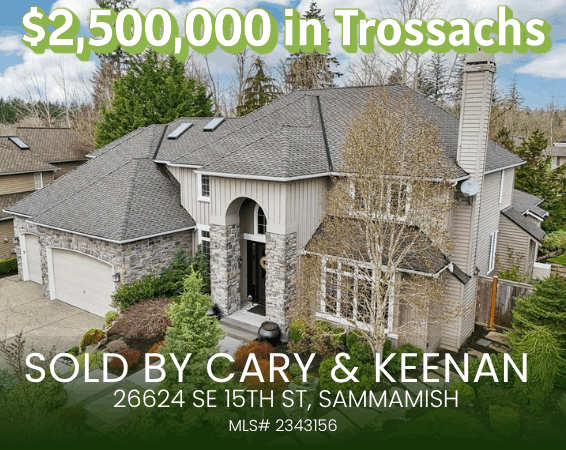
I sold 26624 SE 15th ST, Sammamish, WA 98075 in May for $2,500,000. We went live in early March.
While over the course of the year home median home prices in Trossachs dropped $120,000…. There was a “Best time to list which was in February and March with those homes achieving the highest sales prices of the year.
The Trossachs market started the year in January with a median selling price of $1,838,700 and ended the year at $1,713,680 but that isn’t the FULL story.
If you tried tiframe,the listing of your home for the end of June to coincide with the end of the typical school year, you more than likely closed in the August-September time frame which was a median price of only $1,689,647 which is almost $150,000 below the yearly starting point.
Click here to see the exact neighborhood charts for your area.

These price variations can be very nuanced from neighborhood to neighborhood even within the same city.
In some cases, just one month can mean a difference of hundreds of thousands of dollars. So, if you are planning on selling it may not necessarily be worth trying to “Time” the market for the end of school. Especially if closing in April instead of June means an extra $200,000 or more!
That same sales pattern can be seen around the area from neighborhoods like Klahanie, The Issaquah Highlands, Sammamish as a whole, Issaquah, Bellevue and even out to Snoqualmie Ridge.
For 2026 we are starting the year with the highest level of inventory in 15 years. What that means for the seller out there is that the market will peak earlier this year than last. In fact, by April-May we are expected to hit the highest level of active inventory in the Puget Sound area’s history.
Those conditions lead to the following.
- The housing market will face increased competition in 2026.
- Expectations are for approximately a 5% decrease in prices for 2026.
- Homebuying activity should pick up after a long slump but with rates around 6% and lots of inventory it won’t be enough to lift prices.
- Housing Inventory will hit all time high levels by April-May.
- Bidding Wars will be replaced with MULTIPLE price drops or corrections.
- Interest rates are to bounce around the 6% range.
So, what does “Housing Affordability” mean for sellers in 2026?
To be blunt. The sales price of your home is going to go down.
That doesn’t mean home prices are going to crash, but it does mean that along with moderating interest rates, governmental pressure is going to be on flattening to slightly decreasing the price you can sell you home for.
A new analysis from the Realtor.com® economic research team considers what it would take to restore home affordability to 2019 levels, when the typical mortgage payment was about 21% of the median household income, compared with more than 30% today. The analysis finds it would take:
- Mortgage rates fallingto 2.65%, down from 6.15% currently, or
- Incomes rising 56%to a median of $132,171, up from $84,763 currently, or
- Home prices falling 35%to a median of $397,963 in King County, down from $612,250 last year.
A Great Housing Reset will take shape in 2026. It won’t be a quick price correction, and it won’t be a recession. Instead, the Great Housing Reset will be a yearslong period of gradual increases in home sales and normalization of prices as affordability gradually improves. It will start next year, with incomes rising faster than home prices for a prolonged period for the first time since the Great Recession era.
We expect the median Seattle area home-sale prices to decrease 1-5% year over year in 2026. Prices will move down marginally mostly due to rapidly increasing inventory levels, still-high mortgage rates, along with a weaker economy which will curb demand.
Windermere principal economist Jeff Tucker doesn’t expect to see any price growth in the Puget Sound region as a result of a relatively stagnant market this year.
“Our region has seen inventory basically get back to normal, prepandemic levels,” he said. “It just really feels like it’s swung around to become a buyer’s market this year.”
High mortgage rates, sweeping layoffs and economic uncertainty made buyers cautious, leaving the region with more homes for sale than usual and some listings lingering. Home sales were down slightly through the first eleven months of 2025 compared to the same period in 2024, according to Northwest Multiple Listing Service data.
Going into 2026, sellers will have to continue competing for attention by cutting prices or accepting lower offers, Tucker said.
All of that being said, we have been in this trend for more than six (6) months now with prices steadily moving lower across the area. 2026 is one of the few years where the starting median home price is most neighborhoods is BELOW where it started the year before (2025 in this case).
Here are a few things to look for in 2026

Recent Posts